
We have all seen the funnel below. It is the classic funnel that was designed for the original tech businesses where the output profit was a function of input sales.
More the leads, more the deals, more the wins and more the money. It just worked.
But no longer.

B2B SaaS has evolved with the market behavior in the past decade. It could also be claimed that some of the early apps shaped some of the user behaviors too as much as the market changed the apps development.
Traditional tech business was linear starting with lead cycle to sales cycle. And hence the classic funnel models acquisition only.
Every time you acquire a new customer, you are investing time and resources. Say paid ads (Google Ads, Meta Ads), say event (booth at SaaStr, Dreamforce). There is a cost to acquire the customer (CAC).
Once you have paid money to acquire this customer, it is but obvious that you want to make as much money from this customer as possible aka high Lifetime Value (LTV).
LTV should be at least 3 times the CAC for running a financially healthy SaaS business. If your LTV:CAC ratio falls below 1:1, your business is incurring losses. And then there’s a chance that you have a very high LTV:CAC ratio which may indicate that you are not spending as much as you should for acquiring new customers.
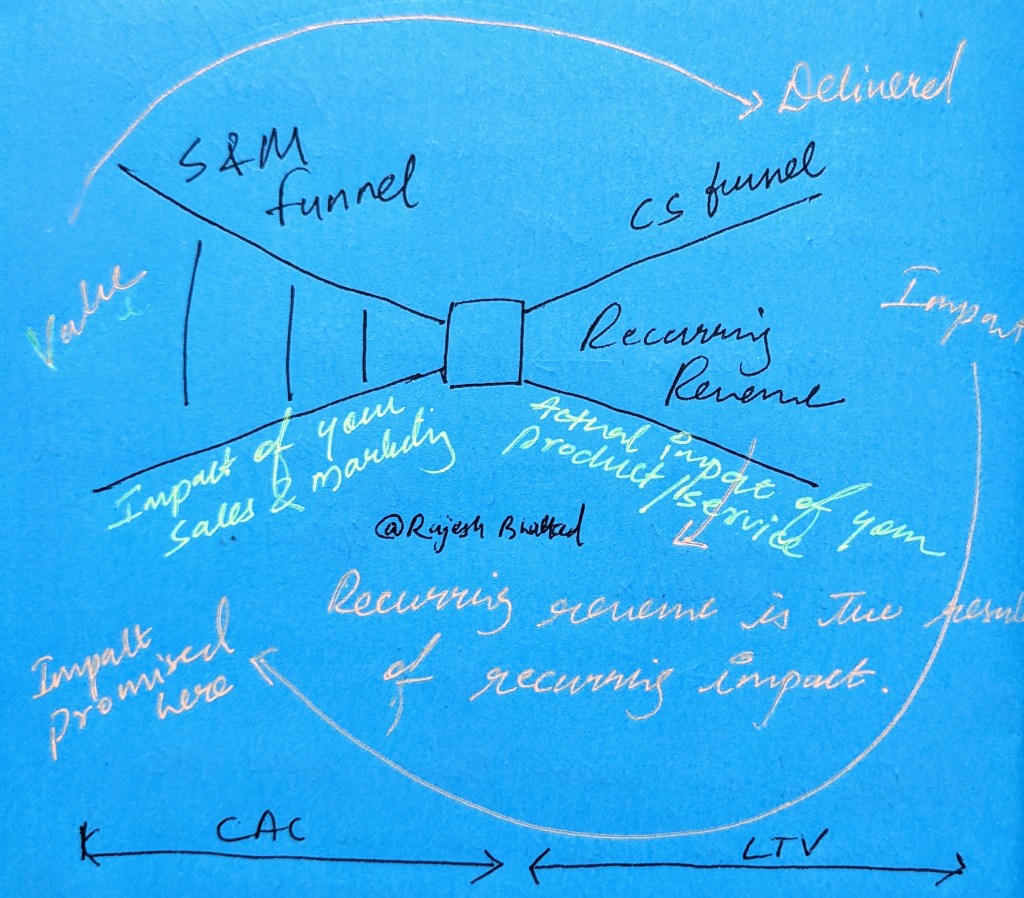
So the classic funnel from leads to first sale is where you incur CAC and everything post-sales is where you make revenue and recurring revenue. This latter part of the funnel when attached to the classic funnel gives you a bowtie funnel to measure your business.

Your sales promises a certain value during the first part of the funnel. The realization of this promised value comes only in the latter part of the funnel post-sales and which is where the customer makes up their mind to buy more licenses or whatever unit of measurement you use for the existing product or purchase other products or services from you.
It is then imperative that the value that was promised in the Sales & Marketing Funnel (S&M) be delivered as impact in the Customer Success funnel (CS) for you to make “recurring revenue” off the same customer with no additional cost beyond the first sale.
According to Bessemer, following are the CAC Payback periods depending on the ARR stage of your company.
| ARR Range | CAC Payback Period |
| $1-$10M | 15 months |
| $10-$25M | 24 months |
| $25-$50M | 20 months |
| $50M-$100M | 21 months |
| $100M+ | 30 months |
I discuss the nuances and shortcomings of the classic funnel and why the bowtie funnel is how you should measure your recurring business in the video below.
 TheSalesOpsGuy